C
Add as a Preferred Source on Google
Add chsgaragerepair.com as a Preferred Source to see more of their content on Google Search.
AddA garage door opener works quietly in the background until the day it grinds, jerks, or simply refuses to lift the door. Knowing how long an opener typically lasts helps Seattle homeowners budget for eventual replacement, avoid sudden lockouts, and take advantage of modern safety upgrades. This in-depth guide covers average lifespans, the biggest factors that shorten or extend service life, cost comparisons between repair and replacement, and easy maintenance you can do to squeeze the most years out of your motor.
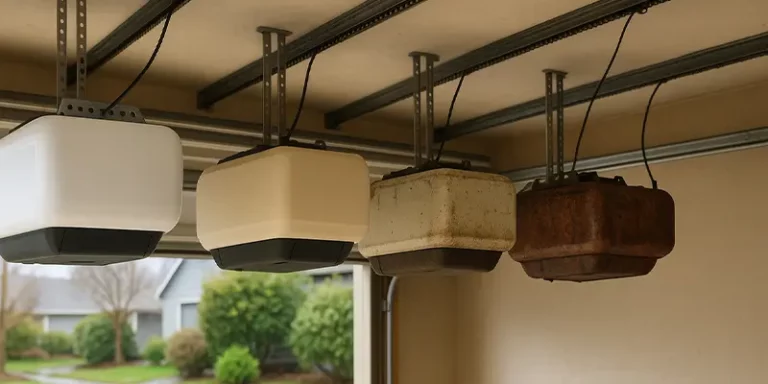
Most residential garage door openers last 10 to 15 years under normal use. Manufacturers measure durability not just in years but in cycles: one full opening and closing action counts as a single cycle.
| Opener Type | Typical Cycle Rating | Years at 4 Cycles per Day |
|---|---|---|
| Chain-drive AC motor | 10,000 cycles | ≈ 7 years |
| Belt-drive DC motor | 15,000 cycles | ≈ 10 years |
| Screw-drive AC motor | 12,000 cycles | ≈ 8 years |
| Direct-drive or jackshaft | 20,000+ cycles | 14 years or more |
A family that opens the door six times on weekdays and eight times on weekend days will log roughly 2,000 cycles per year, reaching the 15,000-cycle mark in about seven and a half years. Light use homes with only two cycles daily can see an opener push past 15 years.
More openings equal more mechanical stress on gears, bearings, and trolley assemblies. Detached garages or homes with alternative entry points rack up fewer cycles and outlast heavily used attached garages.
Seattle’s damp climate encourages corrosion on chain links, screw shafts, and circuit boards. Seaside neighborhoods also battle salty air that accelerates rust. Belts and pulleys hold up better than exposed chains in high humidity.
AC motors have fewer electronic parts but run hotter and vibrate more, wearing gears sooner.
DC motors run cooler, start and stop smoothly, and usually include soft-start logic that reduces shock loads.
Chain-drive models are rugged but noisier and need regular lubrication.
Belt-drive units are quieter and exert less shock at start-up.
Screw-drive openers handle temperature swings poorly if not lubricated with the correct synthetic grease.
Direct-drive or jackshaft models have the fewest moving parts, making them the longevity champions for high-end homes.
An opener that lifts an unbalanced or overweight door strains motor windings and wears out nylon gears more efficient. Poorly adjusted torsion springs are the number-one lifespan killer after neglect.
Loose mounting bolts, misaligned rail brackets, or crooked tracks send vibration back into the chassis, cracking circuit-board solder joints over time.
Biannual lubrication, periodic chain tensioning, and yearly spring balancing can add three to five years of life.
Increasing noise: Grinding, squealing, or rattling that gets worse despite lubrication.
Delay or hesitation: Door pauses mid-way or starts slowly before gaining speed.
Vibration of the rail: Excessive shaking indicates worn trolley or motor bushings.
Remote signal lag: Press the button twice before the motor reacts.
Intermittent reversing: Opener closes halfway then reverses with no obstacle present.
Failure in extreme cold: AC capacitors and aging logic boards struggle at low temperatures.
Missing safety features: Units built before 1993 may lack photo-eye sensors and rolling code encryption.
Frequent repairs: Replacing a gear kit one year and a logic board the next suggests the unit is tired overall.
| Component failure | Recommendation |
|---|---|
| Capacitor or start relay | Repair if opener under 10 years |
| Trolley or carriage | Repair unless other parts also worn |
| Main drive gear and sprocket | Repair once; consider new opener if second failure |
| Logic or circuit board | Replace opener if unit lacks modern safety tech |
| Motor windings burnt | Replace opener |
| Broken chain or belt | Repair if motor is healthy |
New belt-drive smart openers with battery backup and LED lighting are worth considering when an older unit fails. CHS opener installation starts at $549, and opener repairs are quoted on a free estimate after we diagnose the problem. If a repair would cost half or more of a new, safer unit, replacement is usually the better value.
PRICING DISCLAIMER – STARTING PRICES SUBJECT TO INSPECTION
All advertised Starting At prices represent base pricing for standard services, products, or installations under typical conditions and are provided for general informational purposes only. Such prices are not guaranteed final quotes and are subject to adjustment following an on-site inspection and evaluation by a qualified technician.
Final pricing may vary based on several factors, including, but not limited to, door size, type, weight, configuration, installation complexity, existing conditions, required labor, product availability, material specifications, and differences in product brands, grades, quality, or performance.
Additional charges may apply when an inspection identifies necessary repairs, adjustments, replacement components, additional labor, unforeseen complications, concealed defects, safety concerns, or other conditions affecting the proper, safe, and reliable operation of the garage door system.
Certain products, components, or services may be required to ensure proper functionality, compatibility, and safe operation, while others may be optional upgrades or enhancements selected at the customer’s discretion.
Any additional work or charges beyond the originally quoted scope will be disclosed to the customer for review and approval before such additional work is performed.
All final pricing is subject to the customer’s approval of a written estimate outlining the applicable services, materials, and associated costs before work begins. No advertised starting price shall be construed as a binding offer or guarantee of the final service price.
Keep the door balanced: Disconnect the opener, lift manually halfway, and confirm it stays put. Adjust springs if it drifts.
Lubricate quarterly: Use white-lithium grease on chain links and synthetic grease on screw drives. Silicone spray rollers, hinges, and bearings.
Tighten hardware: Quarterly inspection of rail brackets, header mounts, and chain-coupling screws.
Add a surge protector: Protects logic board during lightning storms.
Align photo-eyes: Dirty or misaligned sensors make the motor reverse repeatedly, increasing cycles.
Replace remote batteries yearly: Weak batteries can cause responsive-fire retransmissions that stress receiver circuits.
Check chain or belt tension: Follow manufacturer specs; too tight accelerates gear wear, too loose slaps the rail.
Clean tracks and sweep debris: Grime causes binding that overloads the motor.
Unit is 12 to 15 years old and one major component fails.
Lacks photo-electric sensors, rolling code security, or vacation lock mode.
Door has become heavier due to added insulation or window panels.
Household wants smart-home integration, battery backup, or ultra-quiet operation for rooms above the garage.
Noise complaints from neighbors or family sleeping above the garage.
Does door weight affect opener life?
Yes. An opener is sized for specific door weight. Upgrading from hollow steel to fully insulated panels can add 40 pounds, shortening motor life unless spring tension is recalibrated.
Can lubrication alone solve a noisy chain-drive?
It helps but metal links still slap against the rail. Adding a dampening spring or switching to a belt-drive unit is more effective.
Is a direct-drive opener worth the premium?
For attached homes or owners planning to stay ten plus years, the extra lifespan and near-silent operation justify the higher cost.
Will a surge strip void the warranty?
Most manufacturers allow UL-rated surge protectors. Mount the strip on the ceiling joist for a tidy install.
How often should a professional tune-up be scheduled?
Once a year is ideal for high-cycle homes. Light-use detached garages can stretch to every two years.
Expect 10–15 years from a typical opener, longer with light use and good maintenance.
Moisture, salt air, and poor door balance are the biggest lifespan enemies in Seattle.
Replace the opener when repair costs exceed half the price of a new smart unit or safety features are outdated.
Regular lubrication, balanced springs, and a surge protector are the simplest ways to add additional years of trouble-free service.
By monitoring cycle count, staying ahead of maintenance, and recognizing early warning signs, you will know exactly when to schedule an upgrade rather than face a sudden breakdown.
Is your opener nearing the end of its 10 to 15-year lifespan? CHS Garage Repair provides expert opener installation and scheduled Seattle garage door repair.
Call CHS Garage Repair at (206) 245-5495 or send us a message with what you’re seeing. We’ll talk through the next steps and provide a written estimate before work begins.
Add chsgaragerepair.com as a Preferred Source to see more of their content on Google Search.
Add