Garage door cables are the steel wire ropes that carry the door’s weight in partnership with the torsion or extension springs. When a cable breaks or unwinds, the door loses support on one side and can become stuck, crooked, or dangerous to operate.
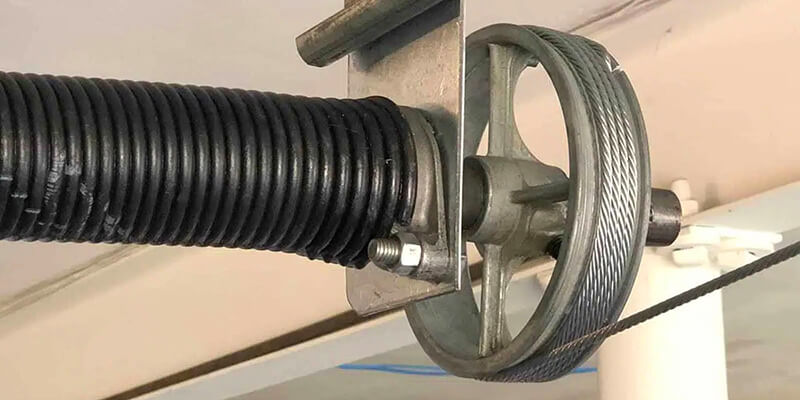
On a standard residential garage door, two lift cables run from the bottom bracket on each side of the door, up along the door’s edge, and wind around a drum mounted on the torsion spring shaft above the door. When you open the door, the spring unwinds and the cables guide the door upward. When you close it, the spring winds back up and the cables lower the door in a controlled path. If you have extension springs instead, the cables run along pulleys on either side and serve the same balancing function.
The cables themselves are braided steel wire, typically 1/8 inch or 3/32 inch in diameter on residential doors, rated to handle the cycling load of the door over years of use. They do not last forever. Corrosion, fraying at the drum, and the accumulated stress of thousands of open-and-close cycles all degrade the cable. In Seattle’s damp climate, cables in garages without good ventilation tend to corrode from the outside inward, which is not always visible until a strand begins to break. Catching the warning signs early is the safest approach.
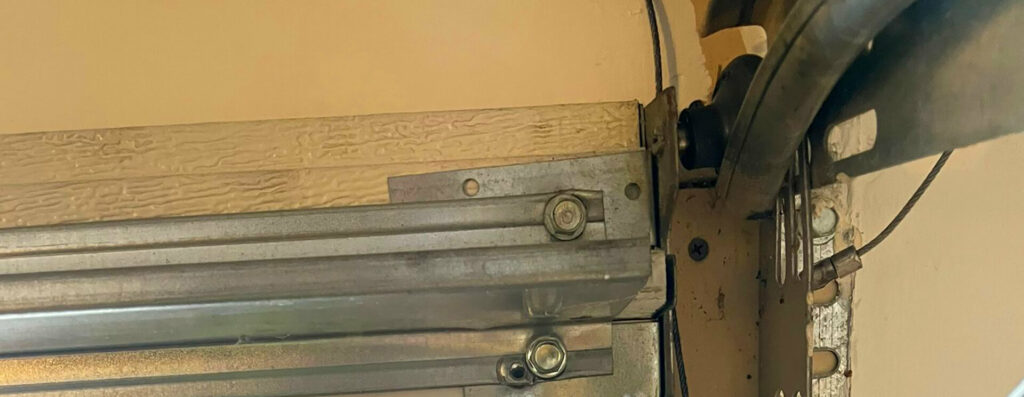
A cable rarely fails without giving advance notice. The most common early sign is visible fraying near the bottom bracket or drum. Look at the point where the cable loops through the bottom bracket fitting on each side of the door. This is the highest-stress point in the cable’s path because the entire load of the door transfers through that small loop fitting on every cycle. Fraying here appears as individual wire strands that have separated and stick out from the main body of the cable.
A second warning sign is a cable that appears slack or loose on one side when the door is closed. The cables should be taut, with no sag. A loose cable means it is no longer carrying its share of the load, which may indicate the cable has partially unwound from the drum or that the spring on that side has lost tension. Either condition puts extra stress on the opposite cable.
Rust or orange discoloration along the cable’s length is also a warning sign, particularly in the section that wraps around the drum. Surface corrosion that can be wiped off is less serious than pitting corrosion that has worked into the wire strands. A cable with deep rust is structurally weakened and should be replaced before it breaks under load.
When a lift cable breaks, the door loses balanced support. On a torsion spring system, the spring is still wound and still holds energy, but that energy now has only one cable path to act through. The door drops on the broken cable side and hangs at an angle. In most cases, the door will not move further because the opener safety mechanism detects uneven resistance and stops, or the door binds in the tracks from the angle. The visible result is a door that is higher on one side than the other and will not respond normally to the opener or wall button.
On an extension spring system, a cable break can be more abrupt. Extension springs run along the horizontal tracks on each side and are stretched when the door closes. The cable on each side acts as a safety restraint as well as a lift component. If the cable on one side breaks, the spring on that side can snap free with significant force. Extension springs should always have safety cables threaded through them for this reason. If your garage has extension springs without safety cables inside them, that is a separate issue worth addressing.
Cables fail for several reasons, and knowing the cause helps prevent a repeat failure after the replacement. The most common cause in residential garages is simple wear at the drum. Each time the door cycles, the cable wraps and unwraps around the drum. The point where the cable enters the drum’s winding groove experiences the highest bending stress, and over 10,000 to 15,000 cycles that stress fatigues the wire strands. A standard residential door cycled four times per day reaches 10,000 cycles in about 7 years.
Corrosion is the second major cause. Cables in garages that are not climate-controlled and have poor ventilation absorb moisture, which accelerates rust formation. In Kirkland and other areas near Lake Washington, garages with water-facing exposures tend to see more efficient cable corrosion than average. Applying a light coat of lubricant to the cables annually slows this process but does not eliminate it.
A cable that breaks prematurely, within the first few years on a newer door, is often the result of improper winding at installation. If the cable is not seated correctly in the drum groove when the spring is wound, it can slip or cross-wind, which creates a pinch point that breaks the cable under normal operating load. This is one reason cable and spring work should be performed by a technician who regularly works with the hardware, not as a first-time DIY project.
The first step is to stop using the door. Do not operate the opener, do not try to manually lift or lower the door, and do not pull the emergency release cord unless you are certain the door is fully resting on the floor (not hanging at an angle mid-travel). A door held up partially by a wound torsion spring and a single cable is not in a stable position, and any additional movement increases the risk of the door dropping suddenly.
If the door is closed and resting on the floor, it is generally safe to leave it in that position until a technician arrives. The spring tension is at its lowest when the door is fully closed, which reduces (though does not eliminate) the risk of an unexpected movement. If the door is open or partially open with a broken cable, do not walk under it. Keep children and pets away from the door area.
When scheduling a repair, be specific about what you observed. A technician who knows a cable broke (rather than just a door that stopped working) will arrive with the correct replacement cable diameter and length for a standard residential door. At CHS Garage Repair, our service vehicles carry standard lift cable sets in both 1/8 inch and 9/32 inch diameters for single and double doors, which covers the majority of residential installations in the Seattle area. You can also visit our garage door cable replacement service page for more detail on what the repair process involves.
When one cable breaks, it is generally advisable to replace both cables during the same service call. The two cables on a garage door are installed at the same time and experience the same number of cycles throughout their life. If one has failed from wear or corrosion, the other has experienced identical stress and is likely at a similar point in its service life. Replacing only the broken cable means the new cable will be paired with an older one that may fail again within months.
The labor cost for replacing one cable versus both cables is nearly identical since the technician already has the spring tension released and the drum accessible to do the work. The material cost for the second cable is modest. From a practical standpoint, replacing both cables in a single visit is the more cost-effective approach over the medium term and avoids a second service call for a predictable failure. The same logic applies to the cable drums: if the drums show significant wear grooves or corrosion, replacing them at the same time as the cables is reasonable preventive maintenance.
Cable replacement on a standard single or double residential garage door in Seattle typically costs between $150 and $250 for both cables, including parts and labor. The cables themselves are inexpensive hardware, usually $10 to $25 per cable. The majority of the cost is labor, since working safely with torsion springs requires releasing the spring tension before the drums can be accessed. If the spring has also failed (a cable can snap when the spring it works with breaks), the combined cable and spring replacement will cost more, typically $200 to $350 depending on spring type and door size. A written estimate is provided before any work begins.
Cable replacement is technically possible as a DIY project for someone with mechanical experience and the correct tools, specifically winding bars for the torsion spring. The primary danger is the torsion spring, which must be unwound before the drums can be loosened. A standard residential torsion spring stores enough energy to cause serious injury if it releases suddenly. Winding bars are required to control the spring safely. Using screwdrivers or other improvised tools in the spring winding cone is a well-documented cause of severe hand and face injuries. If you are not familiar with torsion spring safety procedures, a technician call is the safer choice.
A crooked door is the most common visual symptom of a broken cable, but it is not the only cause. A broken torsion spring on one end of the shaft can produce the same asymmetric drop because the spring is no longer contributing lift on that side. A cable that has unwound from its drum (without breaking) will also cause the door to hang lower on one side. And a severely misaligned track can pull the door off its normal plane. The clearest way to distinguish a cable issue from a spring issue is to look at the cable on the low side: if it is slack, coiled on the floor, or clearly not attached, the cable is the cause. If the cable looks intact but the door still hangs uneven, inspect the spring above the door for a visible gap or separation in the coils.
Standard residential lift cables are rated for approximately 10,000 cycles, which works out to roughly 7 to 10 years on a door used four times daily. Cables in well-maintained, dry garages with annual lubrication can exceed that range. Cables in damp, unventilated garages or those that have been improperly installed may fail earlier. A cable that breaks within two to three years of installation is worth investigating for a root cause: it may indicate an installation problem, an undersized cable for the door weight, or a drum issue that creates abnormal wear at the winding point.
If the door is fully open and the springs are in the relaxed (unwound) state, driving under the door is generally low risk for a brief period. The concern is that a door held in the open position by a spring system with a broken cable may have most of its spring tension still loaded, depending on the spring type and how the failure occurred. On a torsion spring system, the spring is most wound when the door is fully open. If the remaining cable fails while the door is overhead, the door can drop suddenly. The safer approach is to support the door in the open position with locking C-clamps on the track below the bottom rollers before driving under it. Contact a technician as soon as possible to avoid leaving the door in this condition.
Attempting to run the opener with a broken cable can damage the opener’s drive system. With the door hanging crookedly and binding in the track, the motor encounters far more resistance than it is designed for. Modern openers have a thermal protection cutout that shuts the motor down under excessive load, but repeated overload attempts can still damage the drive gear assembly, the trolley carriage, or the rail. Chain and belt drives in particular can be stretched or damaged by the force of trying to move a jammed door. Beyond the opener, forcing the door can also bend track brackets and damage the door panels at the point where the door is binding. The safest approach is to disconnect the opener by pulling the emergency release cord and leave the door stationary until the cable is replaced.
CHS Garage Repair handles cable replacement for torsion and extension spring systems across Seattle and surrounding areas. Our technicians carry standard cable sets on the vehicle and provide a written estimate before any work begins.