
You press the button on your remote, expecting to pull into your garage out of the Seattle rain. Instead of the familiar sound of the door rolling up, you just hear a low, steady hum coming from the motor on the ceiling. The door refuses to budge.
A garage door opener that hums but does not move is a classic symptom of a mechanical bind or an electrical failure. The motor is trying to work, but something is preventing the force from transferring to the door. Before you assume you need a brand-new opener, run through this troubleshooting checklist to find out exactly what is causing the noise.
1. The Door Is Manually Locked
It sounds too simple, but it happens all the time. Many garage doors have a manual slide lock on the inside, usually engaged by a handle or a sliding deadbolt. If someone accidentally bumped this lock into the closed position, the door is physically bolted to the track. When you press the button, the opener motor hums as it strains against the locked door.
-
The Fix: Walk over to the door and check the manual lock. If it is engaged, unlock it. If you tried to open the door multiple times while it was locked, check the top panel for any bending or stress marks.
2. A Broken Torsion Spring
Your opener does not actually lift the full weight of your garage door; the heavy lifting is done by the springs. If a spring snaps, a 150-pound door suddenly becomes a 150-pound dead weight. The opener motor is not strong enough to pull that much weight on its own. It will simply hum, strain, and eventually shut off to prevent overheating.
-
The Fix: Look up at the shaft above the garage door. If you see a gap in the coiled metal spring, it has broken. Do not attempt to lift the door with the motor. If the door feels incredibly heavy or refuses to budge when you lift it by hand, do not force it. You are likely dealing with a broken spring. This requires professional garage door spring repair because those coils hold a dangerous amount of tension.
3. Stripped Nylon Gears
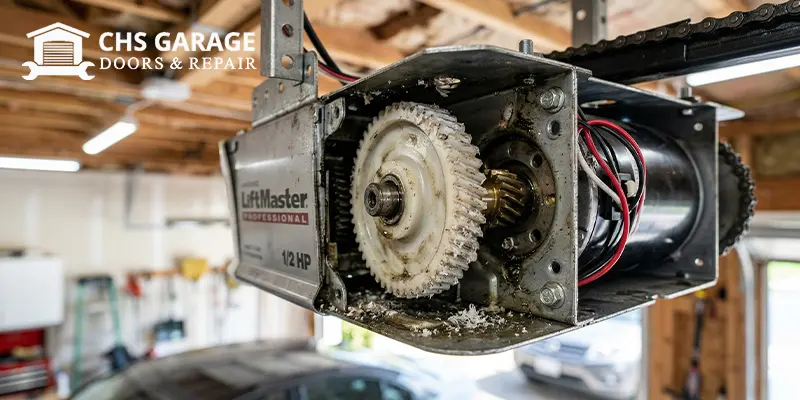
Inside most chain-drive and belt-drive openers is a white nylon gear assembly. This gear takes the rotational force of the motor and transfers it to the chain or belt. Over time, lack of lubrication or lifting an unbalanced door can cause the teeth on this nylon gear to shear completely off.
-
The Fix: If you hear the motor humming or even whirring smoothly but the chain or belt is not moving at all, stripped gears are the likely culprit. Unplug the unit, remove the plastic cover, and inspect the main gear. If you see white plastic shavings inside the casing, the gear kit needs to be replaced.
4. A Blown Motor Capacitor
The capacitor is a small, cylindrical electrical component inside the opener that gives the motor the initial jolt of electricity it needs to start turning. If a power surge hits your home during a Seattle winter storm, or if the opener is simply getting old, this capacitor can bulge, leak, or blow out completely.
-
The Fix: When a capacitor fails, the motor gets power (the hum) but lacks the starting torque to spin. You can often confirm this by carefully removing the motor cover and looking for a black cylinder with bulging sides or leaky fluid. Replacing a capacitor is an inexpensive and efficient fix for a trained technician.
How to Test Your Door
If you hear the hum and need to get your car out, you will need to bypass the motor. You can easily do this from the inside by pulling the red emergency release cord. Once disconnected, try lifting the door manually.
If you are stuck outside in the driveway and the opener is just humming, read our guide on how to manually open your garage door from outside to safely gain access.
Once the door is disconnected from the opener:
-
If the door is easy to lift by hand, the problem is inside the opener motor (gears or capacitor).
-
If the door is too heavy to lift, the problem is with the door mechanics (a broken spring or snapped cable).
Key Takeaways
-
A humming motor means the opener is getting power but cannot spin the drive mechanism.
-
Always check for an accidentally engaged manual lock first.
-
A broken spring will make the door too heavy for the motor, causing it to hum and strain.
-
White plastic shavings inside the motor cover point to stripped gears.
-
A blown capacitor prevents the motor from generating starting torque.