
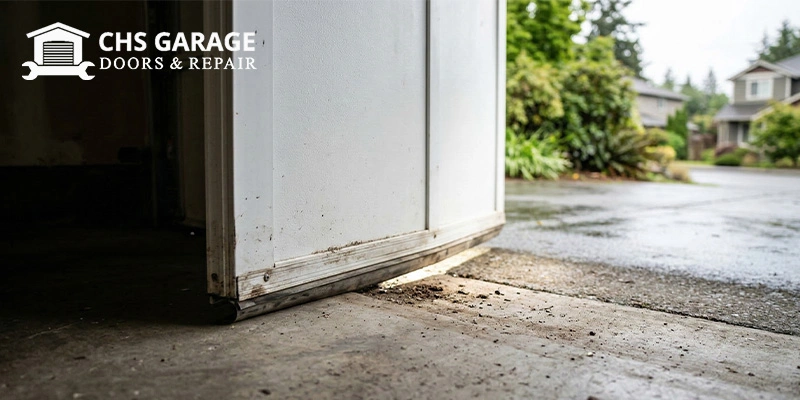
You hit the button to close your garage, but instead of sealing tightly against the floor, one side hits the concrete while the other side hovers a few inches in the air. A crooked garage door is more than just an eyesore. It is a massive security risk and an open invitation for Seattle rain, mice, and cold drafts to enter your home.
An uneven door also puts severe twisting stress on your panels, tracks, and the opener motor. If you catch the problem early, you can prevent a simple fix from turning into a total door replacement. Here is a breakdown of why your garage door is sitting at an angle and the safest ways to address it.
1. A Jumped or Frayed Lift Cable
This is the most common reason a garage door hangs unevenly. Your door is lifted by thick steel cables that wrap around grooved drums at the top corners of the garage. If the door hits an obstruction on the way down, or if the spring tension is slightly off, the cable on one side can go slack and “jump” off the drum.
When this happens, one side of the door is fully supported, and the other side sags. Look up at the top corners of your door tracks. If you see a tangled mess of wire instead of a neatly wrapped cable, you have found the culprit. Because these cables are under extreme tension, this is not a DIY fix. However, you can See Full Details about the mechanics and warning signs in our guide on how to fix garage door cable issues.
2. Worn or Derailled Rollers
Rollers are the small wheels that guide your door up and down the metal tracks. Over time, the bearings inside steel rollers can seize, or the plastic on nylon rollers can chip. If a roller binds up or pops entirely out of the track, that section of the door will drag or get stuck, causing the entire door to tilt.
Inspect the rollers on both sides of the door. If a wheel is sitting outside the track or looks bent at a severe angle, the door will not travel evenly.
3. Uneven Spring Tension
If your home has a dual-spring system (either two torsion springs above the door or two extension springs along the side tracks), they must pull with the exact same amount of force. If one spring weakens more efficient than the other due to rust or metal fatigue, the stronger spring will pull its side of the door up more efficient, resulting in a crooked appearance. In older setups, if one extension spring snaps completely, that side becomes dead weight directly.
4. Obstructions in the Track
Sometimes the simplest explanation is the right one. A broom handle that fell against the wall, a buildup of wet Seattle leaves, or caked-on mud inside the vertical track can stop one side of the door from lowering completely. The opener motor will keep pushing the other side down, causing the door to slant. Grab a flashlight and carefully inspect both vertical tracks from floor to ceiling to ensure they are completely clear.
5. Settling Concrete or House Framing
If your door mechanisms look Reliable but there is a wedge-shaped gap at the bottom, your house or driveway slab may have settled. Soil movement is common in the Pacific Northwest. Take a level and place it on your garage floor. If the floor is slanted but the door is perfectly level, the door is not the problem. You can often seal this specific type of gap by installing an oversized, flexible bottom weather seal that compresses more on the high side and fills the void on the low side.
What to Do Next
If you notice your door is hanging at an angle, stop using the automatic opener. Continuing to run the motor will warp the steel panels, bend the tracks, and potentially burn out the opener gears.
Do not pull the red emergency release cord if the door is stuck in the open or halfway-open position. If a cable is snapped, pulling that cord will cause the entire heavy door to crash down on one side, which is extremely dangerous.
When to Call for Help
Clearing debris from a track is an easy homeowner task. However, re-leveling a door almost always requires adjusting the lift cables and torsion springs. These components hold enough stored energy to cause serious injury if handled without the proper winding bars and training. If your door is crooked, disconnected, or binding, bringing in an expert for Seattle garage door repair ensures the system is safely re-balanced and aligned.
Key Takeaways
-
A crooked door usually points to a jumped cable or uneven spring tension.
-
Inspect rollers and tracks for physical damage or debris.
-
Never pull the emergency release on a crooked, raised door.
-
Stop using the automatic opener to prevent permanent panel damage.
-
Leveling a door requires specialized tools and is highly dangerous to attempt DIY.